

Dongyin Cloud Products | Featuring the transparent Wali supply chain visualization platform
Release time:
2023-04-06
On the afternoon of March 30, at the Dongyin Strategy and New Product Launch Event, the Dongyin product team officially unveiled a comprehensive suite of cloud-based solutions designed for the future of supply chain management. These offerings equip enterprises with the interconnected, transparent, and sustainable capabilities needed to drive digital transformation, enabling a leap‑forward shift in supply chain management—from “physical flow” to “data‑driven connectivity.”
“Transparent supply chain, enabling end-to-end visibility and tracking of goods and orders, helping enterprises make rapid decisions.”
This issue begins with a recap of the launch of Wali, a transparent supply-chain visualization platform.
The supply chain logistics industry, characterized by numerous stakeholders and lengthy operational chains, suffers from widespread information silos and high data‑integration costs. Moreover, in recent years, the COVID‑19 pandemic has exacerbated volatility in international shipping, with frequent schedule disruptions, port call cancellations, and congestion. As a result, many companies are urgently seeking real-time visibility into the execution of each link in their supply chains to mitigate associated losses.
An increasing number of enterprises are exploring or deploying visualization solutions to accelerate digital transformation and continuously enhance their management practices. Against this backdrop, Dongyin Technology has launched the Wali Supply Chain Visualization Platform, helping users break down data silos and reduce the costs associated with data integration.
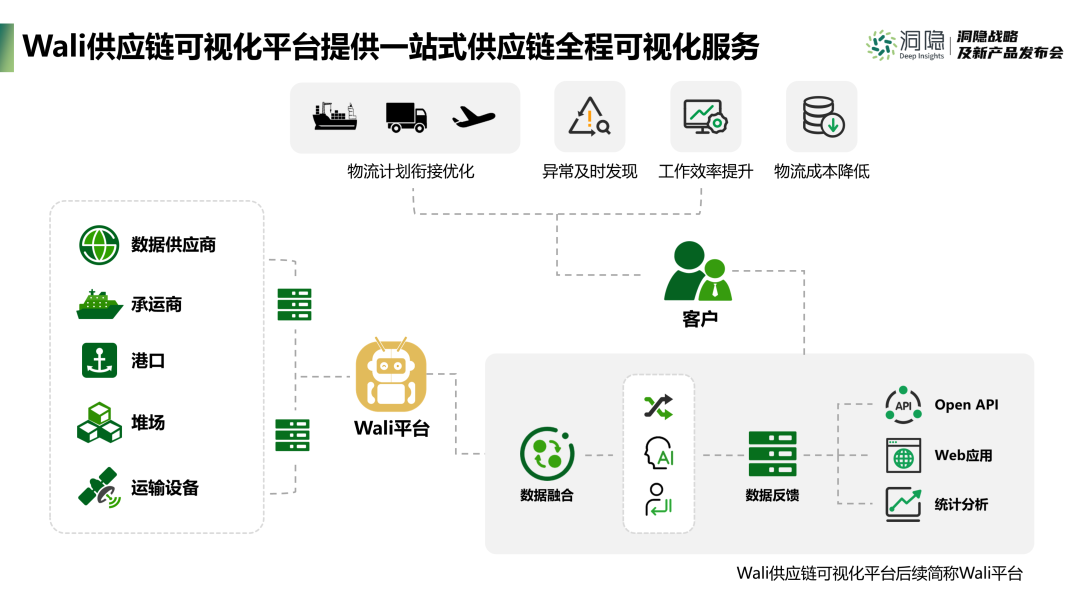
01 The Wali platform provides enterprises with end-to-end, real-time supply chain visibility.
Wali’s standard platform offerings cover maritime, air, rail, and road transportation, providing data‑driven support for capacity planning, cargo tracking, and location services. In terms of service delivery, it leverages data‑as‑a‑service and data‑channel models to meet diverse customer needs.
The Wali platform boasts mature data-processing capabilities, seamlessly integrating diverse types of raw data from carriers, ports, and transportation equipment. Its core production platform supports a full range of ETL operations, features an integrated stream‑batch computing engine and a data‑fusion engine, and can efficiently and reliably perform data cleansing, transformation, and integration tasks. When necessary, it also enables human expert intervention, delivering more accurate and timely visualized insights.
It supports Open API calls and features built-in, mature, and robust web applications and statistical analytics, enabling users to integrate it into their own business systems. This helps customers promptly detect anomalies, optimize the coordination of logistics plans, improve operational efficiency, and reduce logistics costs. Additionally, it has established an enterprise‑grade data security framework to ensure robust data management and protection.
02 Link end-to-end transportation data to track global logistics trends.
The Wali platform’s functionality is divided into two main components. First, there is the supply-chain execution cloud platform integrated with Wali, which enables automated subscription to ocean‑freight tracking, viewing of tracking details, and display of transport‑route maps within the TMS. The second component of Wali’s capabilities includes port‑to‑port vessel schedules, vessel AIS data, and domestic ocean‑freight cargo tracking.
The supply chain execution cloud platform is integrated with the Wali platform, enabling implementation within the TMS system.
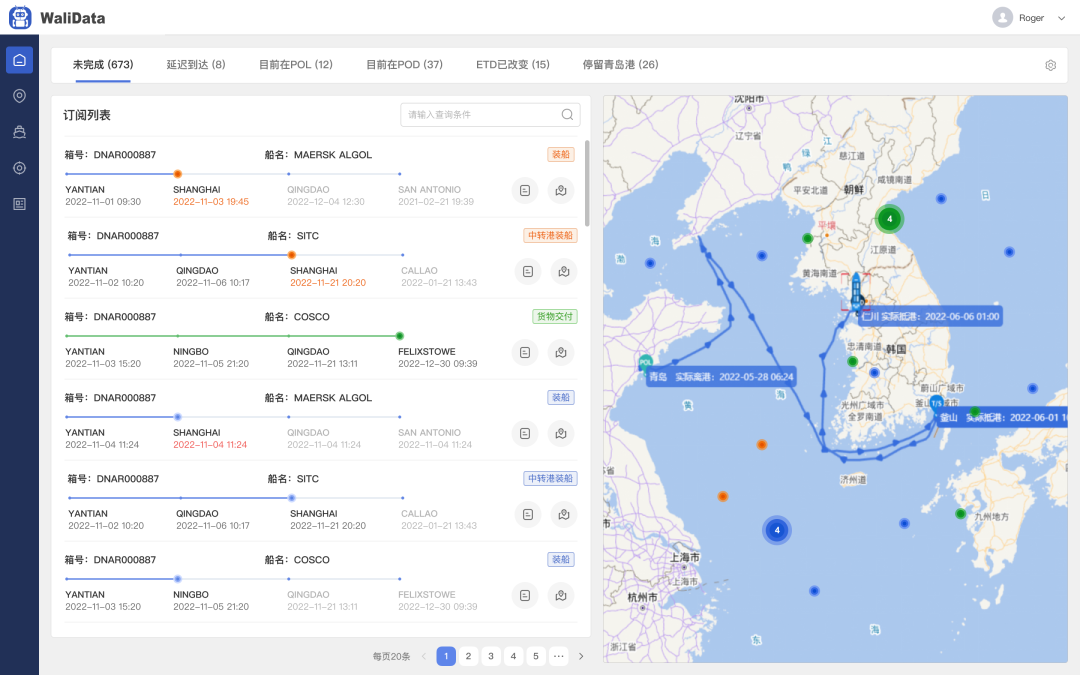
The TMS provides logistics visibility across multiple transportation modes and seamlessly integrates with the Wali supply chain visualization platform. For ocean freight operations, users can initiate shipment tracking subscriptions based on orders, waybills, or directly, with support for automated subscription as well.
For example, to initiate a search, you can enter the master bill number or the container number, along with the corresponding shipping line, to access the ocean freight tracking homepage. There, you can view your subscribed ocean freight tracking information and, by entering the master bill number or container number, look up and select the shipment record whose tracking details you wish to view.
On the details page, you can view port information for each stage of the shipping process, as well as key milestones along the sea‑freight route. The platform also supports map‑based visualization of vessel trajectories, automatically updates estimated time of arrival (ETA) based on subscriptions to the Wali supply chain visibility platform, and provides automated notifications and alerts.
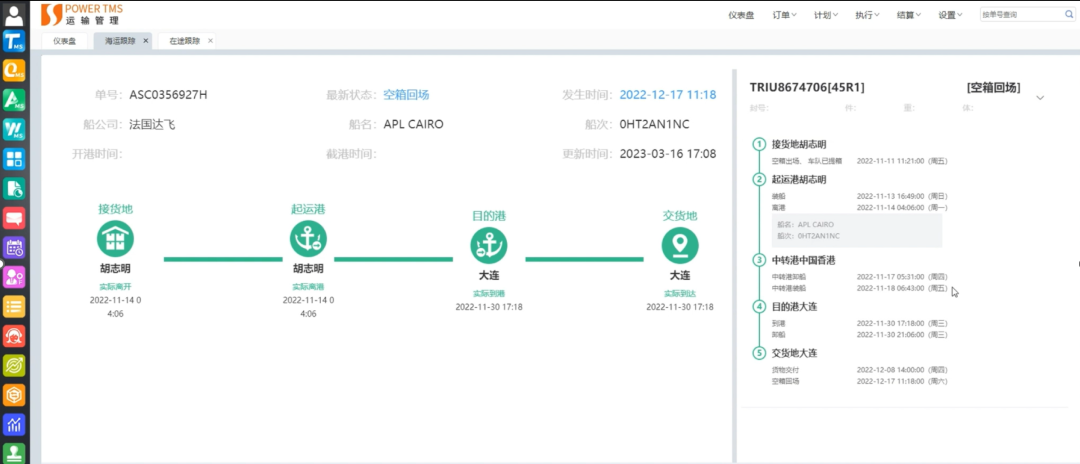
The demo interface is for reference only.
Other features of the Wali platform
01 Port-to-Port Sailing Schedule: The port-to-port sailing schedule provides vessel deployment plans for the next four weeks, helping users make informed decisions when selecting supply chain partners and planning their transportation logistics.
02 Vessel AIS: The vessel AIS location service provides a visualized display of basic vessel information, the vessel’s latest position, historical tracks, and port‑of‑call details, enabling users to monitor vessel operations at any time.
03 Domestic Ocean Freight Tracking: Supports tracking of domestic cargo shipments along China’s coastal routes and the Yangtze River Basin, helping users stay informed about transportation status within the country.
04 Vehicle GPS: The vehicle GPS service allows you to query the vehicle’s latest location and trajectory information at any time, helping users monitor transportation status and plan logistics schedules.
05 Air Freight Flight Tracking The air freight flight tracking service allows users to check the status and estimated transit times of all flights, making it easy to access air freight shipping schedules.
06 Incident Management: Abnormal situations can be flagged in advance through incident management, enabling timely control and mitigation. Incident management also supports custom configuration of anomaly types, with settings covering status changes, exception conditions, and more, helping to identify the root causes that impact the supply chain during the freight‑handling process.
The Wali platform integrates with leading global service providers, currently connecting 43 shipping lines and several major domestic terminals. It supports all container vessels, as well as 89 import‑export airlines and nearly all domestic container trucks.
How can we deliver more accurate data? The Wali platform employs a multi‑data‑source integration approach that not only enhances the value of the data but also reduces the development effort required for integrating and aligning customers’ business systems.
For example, in maritime cargo tracking, data from shipping lines, terminals, and vessel AIS systems often overlap to some extent. Selecting the most accurate data requires adherence to established business rules and industry‑specific expertise.
In this regard, the Wali platform places greater emphasis on user needs: in addition to integrating data from diverse sources, it also supports raw data from RPA‑based automation and EDI‑based data channels. Built on an enterprise‑grade, self‑managed architecture, it delivers high availability, scalability, and exceptional elasticity for seamless data integration.
03 Five Key Features of the Wali Platform
Personalized customization solutions ensure seamless, end-to-end service.
Building on standard products, we offer customizable solutions that leverage RPA digital employees to address gaps in the scope of support. By employing multi‑data integration approaches, we can meet diverse transportation data‑integration needs, seamlessly connect all logistics links across the customer’s supply chain, and help users achieve end-to-end closed-loop supply chain management.
In-depth expertise in domestic maritime cargo tracking
In the domestic maritime and inland waterway transport sectors, leveraging the company’s many years of experience in shipping‑related IT implementation, we have already integrated with numerous domestic shipping lines. Our domestic maritime capacity now accounts for nearly 70% of our total, enabling not only cargo tracking and vessel schedule inquiries but also services such as booking.
ETA makes logistics planning smoother and more seamless.
Estimated Time of Arrival (ETA) plays a crucial role in cargo tracking. By integrating data from multiple sources, the Wali platform can deliver tailored solutions and more precise ETAs on demand, helping customers streamline and optimize their logistics planning.
For example, in ocean freight tracking, the Wali platform not only integrates carrier data and terminal manifest information but also connects to terminal vessel scheduling. It can tailor data‑acquisition strategies to suit short‑haul and deep‑sea routes, and, when combined with AIS, it delivers dynamic vessel‑schedule services.
Proactive anomaly management with timely alerts.
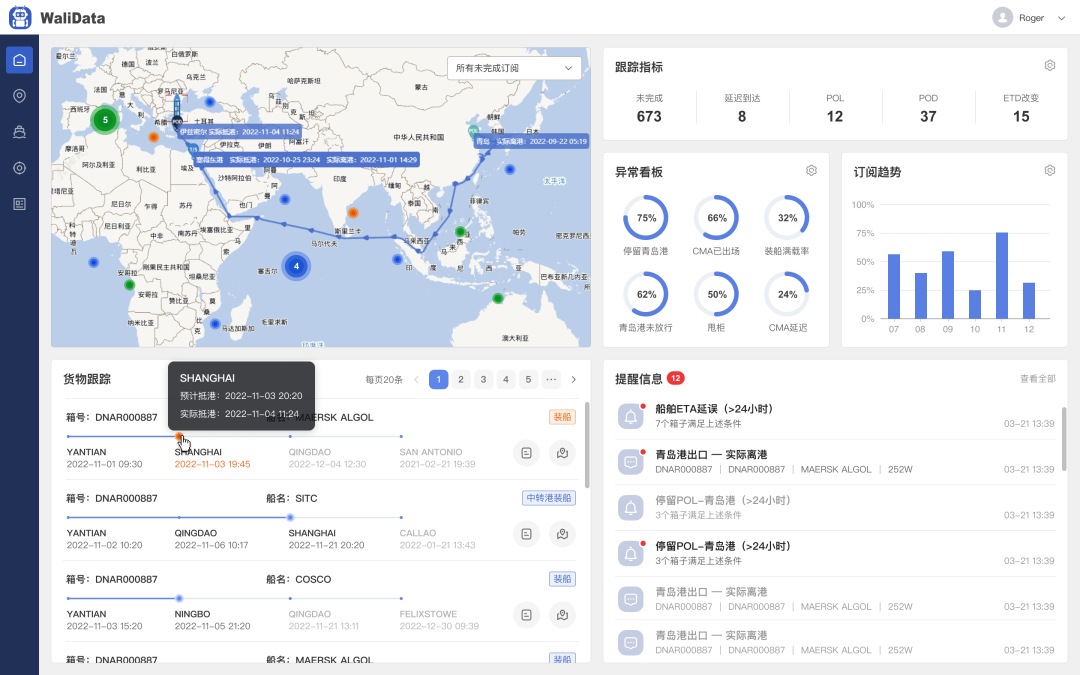
Once you have the data, how can you analyze it more effectively? The Wali platform offers proactive anomaly management: users can not only subscribe to notifications of status changes but also customize anomalies themselves.
For instance, when the ETA has changed or the vessel has been at the loading port for more than two days, you can configure alerts to trigger on demand, immediately, or on a scheduled basis. This ensures that customers receive timely notifications on their mobile devices, helping to mitigate the downstream impact of delays on the supply chain.
Integrate execution data to enable comprehensive analysis.
The Wali platform seamlessly integrates with other business applications in the Dongyin supply chain. Backed by execution data, it not only enables order visibility but also provides end-to-end process transparency. When anomalies are detected at any stage of the supply chain, the platform facilitates timely coordination to resolve issues, ensuring smooth logistics operations.
04 Four Reasons to Choose Wali
Innovative, independently designed, and continuously evolving, it seamlessly blends global reach with local relevance.
Resulting in rapid ROI, with end-to-end support from business and technical experts.
Integration reduces integration effort through multi‑data fusion, seamlessly connects with all Dongyin products, and delivers a truly end‑to‑end visible network. The Wali platform carefully selects leading global big‑data vendors to ensure the most accurate data.
Tag:
Related News

undefined
Trying and Experiencing Immediately.

 Products
 Solution
 Resource
 About Us
Sales Hotline
+86-400-107-7860
Address: Room 1201, Urban Construction International Building, 500 Fushan Road, Pudong New Area, Shanghai
E-mail:info@deepinsights.com.cn
Service Line:+86-400-107-7860

Follow Us

Join our community