

Dongyin’s wholly owned subsidiary, Kejian, has been honored with the 12th Logistics Industry “Oscar” (including a showcase of the winning projects).
Release time:
2023-04-26
Recently, the 12th China Logistics Technology Conference concluded successfully in Shanghai. Concurrently, the LT China Logistics Technology Awards—widely regarded as the “Oscars of the logistics industry”—held its awards ceremony, during which the winners of the various categories of the 12th LT China Logistics Technology Awards were officially announced.
Recently, the 12th China Logistics Technology Conference concluded successfully in Shanghai. Concurrently, the LT China Logistics Technology Awards—widely regarded as the “Oscars of the logistics industry”—held its awards ceremony, during which the winners of the various categories of the 12th LT China Logistics Technology Awards were officially announced.
The LT Award (short for Logistics Technology Award, or China Logistics Technology Award) was established in 2011 and is renowned for its judging principles of fairness, impartiality, transparency, and public benefit. It aims to recognize the latest achievements in the logistics sector, foster cross‑industry innovation in Chinese logistics technology, and promote global connectivity. With its distinctive influence, it has been hailed as the “Oscar of the logistics industry.”
The 12th LT Awards launched online registration on November 22, 2022. Following an initial user review—where more than 2,000 industry professionals cast votes to determine the shortlists for each category—the awards proceeded to a final expert evaluation. A panel of 21 renowned industry experts, academics, and senior user representatives assessed submissions according to established criteria and standards, conducting both online and in-person deliberations to select the ultimate winners. The awards were ultimately announced across four distinct categories.
Among them, the entry “Zhongchu Bulk Commodity Futures Delivery Digital Intelligence Platform” was awarded the 2023 12th LT China Logistics Technology Award for Innovative Application, thanks to its innovative, forward-looking, practical, and scalable technological solutions. After more than three months of intense competition, the project—jointly submitted by the technology provider, Keliang Software, and the user, Zhongchu Development Co., Ltd.—received this prestigious honor.
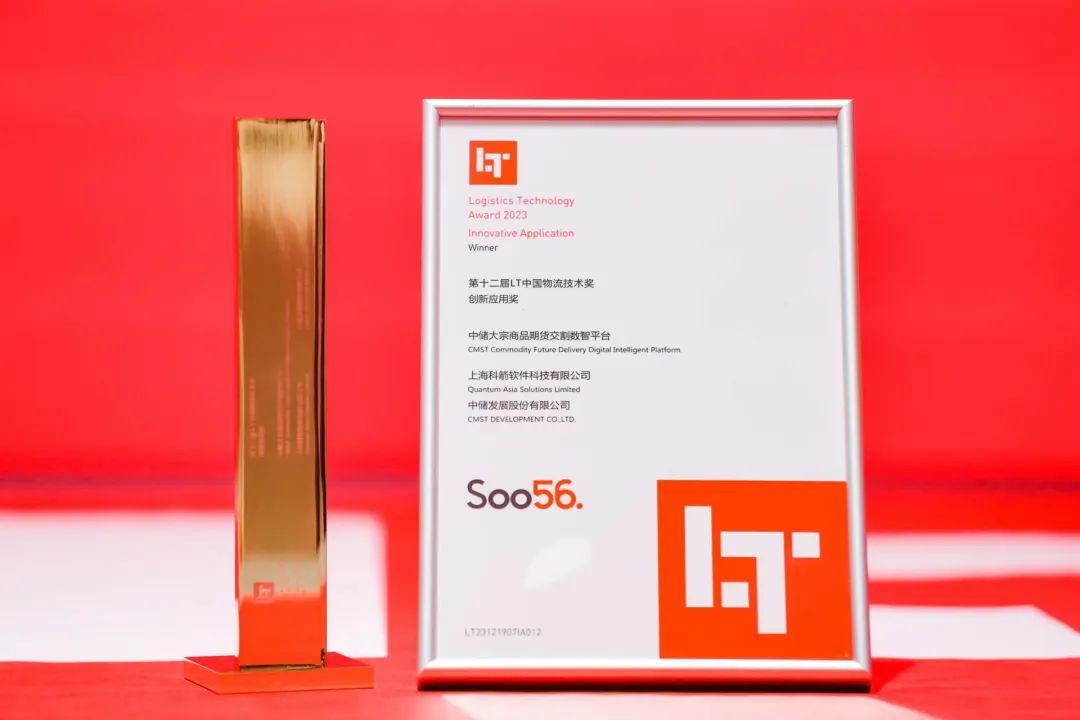
The Innovation Application Award aims to identify successful cases that demonstrate the practical implementation and commercialization of innovative logistics technologies. It evaluates whether the project’s key technological innovations and operational outcomes have substantially enhanced enterprise efficiency, met technical, economic, and environmental performance standards, and possess broader industry‑wide applicability and scalability.
⬇ Comprehensive Showcase of Award-Winning Innovative Applications ⬇
Sinotrans Bulk Commodity Futures Delivery Digital Intelligence Platform
CMST Commodity Future Delivery
Digital Intelligent Platform
Project Background
China National Materials Storage and Transportation Group Co., Ltd. is a large central enterprise under the supervision of the State-owned Assets Supervision and Administration Commission of the State Council, and is part of China Logistics Group Co., Ltd. The company has a registered capital of RMB 239,925.53 million and employs 6,051 staff members. It was among the first batch of national 5A‑level logistics enterprises.
To enhance the quality of warehousing services for delivered commodities, improve on-site operational management and risk‑control capabilities, and lay a solid foundation for the subsequent remote‑management platform, Sinograin Group has decided to launch the “Sinograin Bulk Commodity Futures Delivery Digital Intelligence Platform” project. By leveraging digital and intelligent technologies, the platform will expand its functionality, providing end‑to‑end support for integrated operations across customers, contracts, warehousing, and transportation, thereby strengthening the core competitiveness of supply‑chain services within the industry ecosystem.
Project Objectives
The extent to which a trading firm penetrates the upstream and downstream supply chains of bulk commodities determines its market influence. Accordingly, Sinotrans Storage & Transportation aims to build an intelligent digital platform for commodity futures delivery that integrates order management, contract control, warehouse management, transportation management, settlement management, data analytics, and remote business processing. By incorporating emerging technologies and advanced hardware into this new system, it seeks to replace traditional manual verification and oversight processes, achieving “document digitization, process visualization, IoT-enabled park operations, integrated services, and platform‑based business operations,” thereby meeting customers’ needs for unified login and multi‑warehouse management.
Solution
Based on the aforementioned overarching objectives, Kojian Software leveraged the Power SCM Cloud supply chain platform and, in alignment with the business characteristics of Sinotrans Shanghai, developed a digital intelligence platform for commodity futures delivery. This platform adopts an integrated architecture comprising OMS (Order Management System), WMS (Warehouse Management System), and TMS (Transportation Management System), providing customer self-service and business expansion support at the operational level, while offering real-time data visualization and analytics to corporate management, thereby facilitating informed decision-making.
01. Document Digitization Solutions
The platform has pioneered the transition of on-site physical delivery procedures to an automated online process, eliminating the previous bottlenecks caused by paper-based, in-person submissions. This has significantly enhanced both the efficiency and accuracy of physical delivery processing; for instance, it saves more than three hours per day for each batch of 500 transfer orders.
02. Process Standardization and Visualization Solutions
Operational processes within the plant are standardized and fully traceable. The Kejian Supply Chain Cloud Platform allows enterprises to customize workflows according to their specific needs. In this project, in addition to the standard procedures, we added custom workflows—“Dispatch” and “Pre-Delivery Inspection”—based on on-site conditions. Furthermore, we tailored and designed all RF‑based functionalities for Zhongchu, ensuring process standardization and rigorous control. Specifically, the subsequent workflow cannot proceed unless the preceding one has been completed, thereby mitigating many issues that can arise in manual management—for example, if dispatch has not assigned a vehicle to a designated area, the area’s tally clerk would be unable to perform acceptance checks.
03. IoT-Based Solutions for Industrial Parks
■ Implement barcode-based management for goods. Provide dedicated labels for bulk non-ferrous commodities, optimized for yard operations, with label formats consisting of a prefix corresponding to each Zhongchu Shanghai warehouse name followed by an auto-incrementing serial number. Labels are printed in advance and affixed during the initial receipt upon warehousing; for rubber products, specialized containers are pre‑equipped with LPN barcodes, and all subsequent handling is tracked and managed via these codes, thereby enhancing operational efficiency and accuracy.
■ The exchange maintains stringent quality-control standards for weight discrepancies. To this end, the platform has implemented paperless acceptance, using RF technology and the electronic scale’s Bluetooth interface to capture real-time weights and store them in the backend, thereby reducing human error.
04. Integrated Service Solutions
The platform has integrated with third-party financial cloud services, enabling online payment collection, real-time fund transfers and top-ups, and automated bulk invoicing. Moving forward, the system will also be connected to inspection‑company systems, customs operations, and freight‑forwarding platforms, further expanding its scope of integrated functionalities.
05. Business Platformization Solutions
■ Standardize the cargo owner operation workflow. By adding a PUBLIC cargo owner and establishing a single, unified set of processes and product catalogs that all other cargo owners can reference, we’ve streamlined operations. For example, under the previous system architecture, each cargo owner maintained its own distinct product catalog—meaning 10,000 cargo owners could end up with 1 million unique products. Now, a single catalog of just 100 products suffices. In addition, we’ve introduced global contract settings: once configured, contracts are automatically synchronized across all sub‑warehouses. Together, these two features significantly reduce the effort required for initial data setup and ongoing maintenance.
■ Contactless pickup solution. Drivers and designated handlers register and complete real-name verification via an online pickup mini‑program, after which the system automatically generates their basic master data. Handlers and drivers can schedule pickup times, make payments, and request invoices online. The system then automatically produces electronic delivery notes and exit permits, enabling drivers to coordinate vehicle entry, order picking, and departure in an orderly manner, thus facilitating contactless entry and pickup.
■ Given the high value of bulk commodities, the platform has also enabled remote query functionality for warehousing clients, allowing them to access real-time information on inbound and outbound shipments, inventory levels, and associated fees, thereby facilitating timely decision-making.
Technological innovation
This project integrates cutting-edge digital technologies—including cloud computing, mobile social networking, the Internet of Things (IoT), an open API platform, and big data—to enhance the efficiency of Sinotrans’ supply chain management and enable seamless collaboration and end-to-end data integration across supply chain operations.
01. Cloud computing drives rapid collaboration across the upstream and downstream value chain, as well as between internal and external stakeholders.
This project leverages cloud computing to build a SaaS‑based supply chain system that not only efficiently connects upstream and downstream stakeholders as well as internal and external information flows, enabling centralized deployment and unified management, but also offers more convenient feature customization and upgrades, more flexible pricing models, faster deployment, and enhanced security—while reducing enterprises’ investments in IT personnel and equipment maintenance.
02. Mobile Social Networking Integrates the Entire Business Process
Mobile internet technology streamlines information flow throughout the supply chain, providing Zhongchu’s shippers, warehouse operators, drivers, and customers with an open, interconnected mobile platform that enables real-time data sharing and boosts operational efficiency. The system supports event‑based subscriptions, automatically delivering notifications via email, SMS, a mobile app, and WeChat official accounts—covering events such as outbound shipments, billing details, and deposit updates—thereby fostering convenient self‑service for employees and customers.
03. Optimizing On-site Operations Through IoT Integration
The integrated logistics supply chain management system, which combines software and hardware, helps Sinotrans comprehensively enhance the level of digitalization across all links in its logistics supply chain. For example, it connects the supply chain system with various IoT devices—such as barcode scanners, access control systems, surveillance cameras, GPS trackers, and temperature‑monitoring sensors—to exchange relevant data and feed it back to different operational stages for execution and verification, thereby reducing inefficient manual processes and enabling end-to-end traceability of on-site operations.
04. Open APIs Facilitate Supply Chain Integration
The system provides hundreds of standard API interfaces, supporting the integration of mobile apps and a wide range of smart software and hardware. It seamlessly connects with Sinotrans’s existing IT systems and hardware equipment, while also enabling standardized data exchange with the information systems of upstream and downstream partners, thereby establishing an integrated management and control framework that encompasses sales, warehousing, transportation, and financial management.
05. Big Data Supports Intelligent Decision-Making
Big data technologies can comprehensively collect structured and unstructured data—including transactional data, phased‑data sets, social network information, customer service platform logs, temperature readings, QR codes, images and videos, voice recordings, and geospatial data—as well as IoT and multimedia data. By leveraging a logistics control tower to analyze this data, organizations can extract actionable insights and generate a variety of management‑oriented analytical reports, thereby supporting operational decision‑making.
Project Outcomes
With the high regard and strong support of all levels of leadership at Sinotrans Shanghai, and thanks to the full cooperation of all departments, the Sinotrans Bulk Commodity Futures Delivery Digital Intelligence Platform—built on the Keliang Power SCM Cloud supply‑chain platform and tailored to Sinotrans Shanghai’s specific business needs—has now been successfully launched and is in operation, achieving process standardization, continuous optimization, and a comprehensive system upgrade.
01. Standardization of Management Processes
Following the system upgrade, a centralized deployment approach has been adopted, enabling the Shanghai Regional Business Unit of Sinotrans to implement multi-warehouse and organizational-level centralized control in alignment with its organizational structure. Standardized configuration of management processes and rule‑based policies across product lines ensures full harmonization of warehouse management procedures throughout the Shanghai Regional Business Unit.
02. Refined Warehouse Slot Allocation
Building on the existing large‑area storage layout, we have implemented a refined zoning and layering system. Each on‑site storage location is labeled with PET‑based, waterproof barcode tags, enabling rapid and precise item localization and boosting operational efficiency. With the digitalization of storage locations, the system now supports visual inventory queries.
03. Barcoding of Products and Containers
Color‑coded product labels are assigned using a prefix corresponding to the name of each Sinotrans Shanghai warehouse, followed by an auto‑incrementing serial number. These labels are printed in advance and affixed during the initial receipt of goods into the warehouse. For rubber products, dedicated containers are pre‑labeled with LPN barcodes, and all subsequent operations are managed based on these codes. All in‑warehouse processes are tracked and controlled via barcodes, enhancing operational efficiency and accuracy.
04. Standardization of Work Processes
Based on dimensions such as product type, order category, and delivery method, you can configure distinct operational workflows and establish tailored processing rules at the level of the smallest inventory unit, thereby better aligning with evolving business needs. Through these workflow and rule configurations, the system‑driven execution of tasks is made explicit, reducing reliance on individual expertise.
05. Automated Expense Settlement
Access control and historical data retrieval are provided for the creation, review, activation, and modification of contracts and rate schedules. Furthermore, based on the configured contracts and rates, the system automatically calculates charges, enhancing efficiency and reducing the risks associated with manual processing.
06. Streamlined Business Processing
The system enables end-to-end monitoring and management of business processes, providing real-time visibility and driving process progress. Key business workflows have been significantly optimized: for instance, a graph‑based algorithm for transfer‑of‑ownership transactions has enhanced operational efficiency, automated invoicing has streamlined interdepartmental collaboration, and electronic signatures combined with remote client access have delivered greater convenience and efficiency to customers.
07. Rich configuration options + custom extensions
The system offers a wide array of professional‑grade configuration options and customizable extension modes at the business integration, service consolidation, and operational connectivity levels, thereby supporting continuous system upgrades.
08. Big Data Analytics
Through visual dashboards, effective insights are conveyed clearly and accurately from vast, complex business data. Multi-dimensional metrics such as workforce productivity, financial flows, and real-time inventory levels are readily accessible at a glance. Users at all organizational levels can perform ad-hoc data analysis and monitoring to support informed business decision-making.
Chen Guangjun, Deputy General Manager of Sinotrans Shanghai
The following evaluation is provided for the project:
“
From a management perspective, first, the launch of the Sinotrans Bulk Commodity Futures Delivery Digital Platform not only signifies a comprehensive upgrade of the warehousing system but also substantially enhances the company’s managerial capabilities. Second, the cloud‑based deployment model eliminates the need for Sinotrans to establish a dedicated operations and maintenance team; instead, a specialized vendor provides professional services, enabling flexible system updates and optimizations in response to business growth and evolving needs—thereby alleviating many operational concerns and fostering a green supply chain. Moreover, this system has enabled Sinotrans Shanghai to achieve truly holistic, enterprise‑wide management: regardless of how many additional sites are added in the future, the business system can be swiftly replicated and operated.
From an application perspective, every business process is now fully visualized, enabling end-to-end monitoring—from the arrival of transport vehicles at the warehouse to unloading and receipt. Overall operational efficiency and customer self‑service capabilities have improved significantly, alleviating pressure on frontline and second‑line operations. Looking ahead, Sinotrans will continue to leverage the Keliang Supply Chain Cloud platform to drive digitalization and informationization across the bulk commodities market.
Tag:
Related News

undefined
Trying and Experiencing Immediately.

 Products
 Solution
 Resource
 About Us
Sales Hotline
+86-400-107-7860
Address: Room 1201, Urban Construction International Building, 500 Fushan Road, Pudong New Area, Shanghai
E-mail:info@deepinsights.com.cn
Service Line:+86-400-107-7860

Follow Us

Join our community